Relapse is not a moral failure. It is, in many ways, a predictable outcome of how addiction physically rewires the brain.
When someone relapses, the first reaction from family, from friends, sometimes from the person themselves is often shame. “They were doing so well.” “How could they go back to that?”
I have heard these words more times than I can count. And every time, I want to sit people down and walk them through what neuroscience has spent the last two decades uncovering: relapse is not a choice made in a moment of weakness. It is, at least in part, the brain operating exactly as it was conditioned to operate responding to learned cues, starved of its own dopamine, and struggling to override deeply carved habits with a prefrontal cortex that addiction has already compromised.
This does not mean recovery is impossible. Quite the opposite. But if we want to support people meaningfully, we must start with the truth about what we are dealing with.
Addiction physically changes the brain
Before we can talk about relapse, we need to understand what prolonged substance use does to the brain. This is not a metaphor. Neuroimaging studies have shown, repeatedly, that addiction produces measurable, structural changes in the very circuits that govern decision-making, impulse control, and the ability to feel pleasure.
Here is the short version: every drug of abuse, alcohol, opioids, cocaine, methamphetamine floods the brain’s reward system with dopamine. The nucleus accumbens, sometimes called the brain’s pleasure center, lights up. But the brain is not built to sustain that kind of signal indefinitely. So, it adapts. It starts producing less dopamine on its own and becomes less sensitive to it.
Over time, everyday things like a meal, a conversation, a walk outside stop generating the same sense of reward they once did. The drug becomes, neurologically speaking, the most compelling source of relief the brain can identify.
At the same time, the prefrontal cortex the region responsible for weighing consequences, regulating impulses, and making long-term decisions begins to lose its grip. Research has shown that a smaller prefrontal cortex volume in people who have been through addiction correlates with a shorter time to relapse after treatment. The brain’s braking system weakens precisely when it is needed most.
The cue problem: why ordinary things trigger extraordinary urges
Here is something that surprises a lot of people: relapse often has nothing to do with the person consciously wanting to use again. It can be triggered by a smell, a song, a street corner, a time of day. This is not random. It is the result of something called cue-induced craving, and it is one of the most well-documented phenomena in addiction neuroscience.
“Exposure to drug-associated cues triggers craving and increases relapse risk. This reflects the enhanced and enduring motivational effect of these cues a neurobiological and behavioral response referred to as cue reactivity.” — From a 2024 preprint study on opioid-related dopamine neuron cue reactivity, bioRxiv
What happens is this: during active addiction, the brain links the experience of using to whatever environment, people, or sensory cues were present. These associations are stored in long-term memory as powerfully reinforced pathways. After someone gets sober, those pathways do not disappear they lie dormant, waiting. When a person encounters a cue that was present during past drug use, the brain fires along those old pathways and generates craving automatically, sometimes before the person is even consciously aware of it.
A Stanford study published in JAMA Network Open demonstrated this in real time: neural responses to drug cues measured in the nucleus accumbens and prefrontal cortex of patients in treatment were directly predictive of who would relapse within 90 days after discharge. The brain, in other words, was already signaling vulnerability before the person had made a single conscious decision.
Stress is not just a feeling, it is a neurological relapse trigger
Stress is one of the most reliable predictors of relapse across all substance use disorders, and the reason goes deeper than “people use to cope.” Chronic drug use fundamentally disrupts the brain’s stress-response system. Key limbic structures the amygdala and the ventral tegmental area become hyperreactive to stress after prolonged substance exposure.
What happens in the brain during stress-induced relapse:
1. The amygdala goes on alert. It becomes highly responsive to stressors and drives the anxiety, irritability, and emotional discomfort that characterize withdrawal even weeks or months after last use.
2. Dopamine signals drop. Stress disrupts the pathway from the ventral tegmental area to the nucleus accumbens, reducing the brain’s capacity to experience reward from normal sources and intensifying cravings.
3. The prefrontal cortex loses the argument. Research shows that diminished prefrontal cortex control over the extended amygdala especially in people with PTSD is particularly linked to stress-induced relapse.
This is also why co-occurring mental health conditions depression, anxiety and PTSD raise relapse risk so significantly. According to the 2023 National Survey on Drug Use and Health, among the 48.7 million Americans with a substance use disorder, more than 55% also had a diagnosable mental illness. When untreated, that emotional burden sits like kindling next to a flame.
The brain can heal and that changes everything
None of what I have described above means that recovery is a lost cause. It absolutely is not. In fact, this is the part of the neuroscience that I find most powerful, and that I wish more people heard: the brain is plastic. It changes. And with sustained abstinence and the right interventions, many of those addiction-related changes begin to reverse.
Recent systematic reviews of neuroplasticity in substance use disorder (2020–2025) confirm that people in recovery show measurable improvements in brain function including increased activity in areas linked to self-control, cognitive flexibility, and emotional regulation. The glutamate system disrupted by addiction and strongly associated with craving begins to rebalance. Brain-derived neurotrophic factor (BDNF), a protein critical for forming healthy neural connections, begins to recover. The prefrontal cortex, gradually, starts to regain its influence.
Recovery is far more common than we talk about
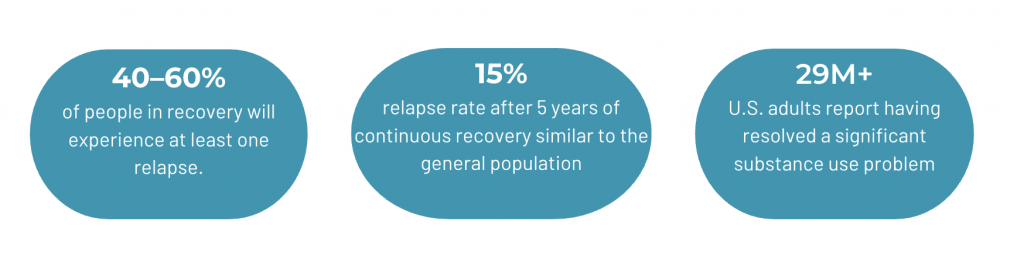
A 2024 landmark report from the Recovery Research Institute found that an estimated 29.3 million U.S. adults about 1 in 9 reports having resolved a significant substance use problem. Among those in remission, more than half achieved it without formal treatment. Community, relationships, purpose, and time all play a role that medicine alone cannot replicate. After five years of continuous recovery, the relapse rate drops to approximately 15% comparable to the general population.
So, what does this mean in practice?
If relapse is partly a brain event, then how we respond to it matters enormously. A relapse is not evidence that someone has failed or that recovery is not possible for them. It is information. It tells us something about which cues are still powerful, what stressors are unmanaged, what support structures need reinforcing.
It also means that treatment cannot end at discharge. A brain that has been reshaped by addiction over months or years does not fully rewire in 30 days. The post-treatment period especially the first 90 days is when relapse risk is highest, and it is precisely when people are most often left without intensive support. Continuing care, peer connection, and mental health treatment during that window are not optional extras. They are the intervention.
And for families and communities the language we use around relapse matters. Shame is not a therapeutic tool. It activates the very stress pathways that drive people back to substances. Curiosity, consistency, and compassion are and the neuroscience backs that up.
Recovery is not a straight line. It is a gradual reclaiming of the brain, of the self, of a life. And the fact that it is hard does not mean it is not happening.
At Reclaiming Life from Addiction, we believe that understanding the science is part of reducing the stigma. The more clearly, we see what addiction is, the more effectively we can respond to it with intelligence, with evidence, and with humanity.
If this resonated with you, share it with someone who needs to hear it. Knowledge is the first step.
KEY REFERENCES
- Goldstein, R.Z. & Volkow, N.D. (2011). Dysfunction of the prefrontal cortex in addiction: neuroimaging findings and clinical implications. Nature Reviews Neuroscience, 12, 652–669. PMC3462342
- MacNiven, K.H. et al. (2018). Association of neural responses to drug cues with subsequent relapse to stimulant use. JAMA Network Open, 1(8), e186466. PMC6324538
- Surgeon General’s Report on Alcohol, Drugs, and Health (2016). Chapter 2: The Neurobiology of Substance Use, Misuse, and Addiction. NBK424849
- Venniro, M. et al. (2020). Improving translation of animal models of addiction and relapse by reverse translation. Nature Reviews Neuroscience, 21, 625–643.
- Ceceli, A.O., Bradberry, C.W. & Goldstein, R.Z. (2022). The neurobiology of drug addiction: cross-species insights into the dysfunction and recovery of the prefrontal cortex. Neuropsychopharmacology, 47, 276–291.
- Recovery Research Institute / NSDUH (2023–2024). Addiction Recovery Statistics. addictionhelp.com
- Frontiers in Molecular Neuroscience (2026). Neuroplasticity and recovery of the brain affected by substance use disorder. PMC12979374