Behind every statistic is a person who woke up one morning and didn’t recognize themselves. This is what it actually feels like to live inside addiction.
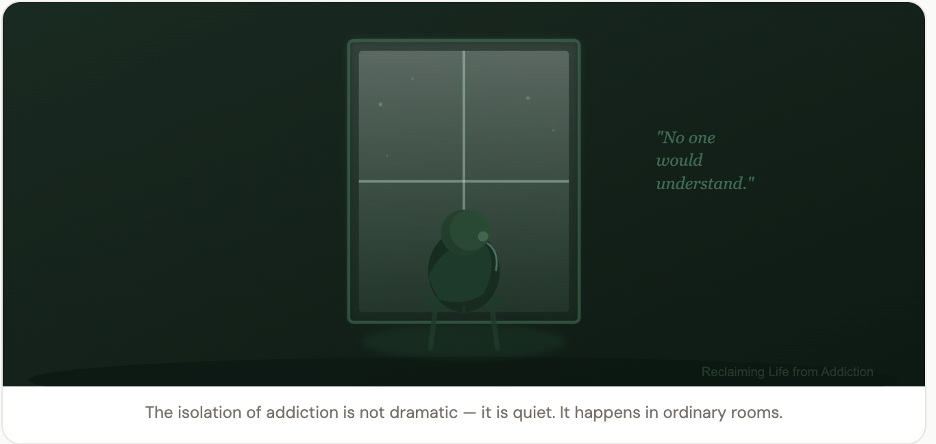
Nobody wakes up one day and decides they want to become addicted. That is not how the story starts. Usually it begins with something ordinary a drink to take the edge off a hard week, a painkiller after surgery, something shared at a party when you were eighteen and trying to figure out who you were. It starts small. It starts manageable. And then, at some point that is almost impossible to pinpoint in hindsight, it doesn’t feel manageable anymore.
But here is the thing almost nobody talks about for a long time, it does not even feel like a problem. It feels like a solution.
When It Starts Feeling Like Relief
Think about Marcus (not his real name), but a composite of stories I have encountered in my work. He grew up in a household where emotions were not discussed. Feelings were something you swallowed. By the time he was in his mid-twenties, working a demanding job and carrying anxiety he had never once named out loud, he discovered that a few drinks after work made the noise in his head go quiet.
“It wasn’t like I was chasing a high,” he once described. “It was more like I finally found an off switch. And I had never had one before.”
This is the part of addiction that shocks people when they really hear it: substances often work. Not permanently, not without cost, but in the short term they do exactly what the person needs them to do. They quiet anxiety. They numb grief. They lower the threshold of social terror. For someone who has been carrying unbearable emotional weight with no tools to manage it, relief, any relief can feel like a lifeline.
Research on the opioid system and social bonding has found that opioids, in particular, create a sensation of warmth and belonging described by many who have experienced it as something like “a hug from the inside.” For people who have spent their lives feeling emotionally untethered, that feeling is not just pleasant. It is profound. And the brain, very quickly, begins to remember how to get back to it.
The Invisible Wall
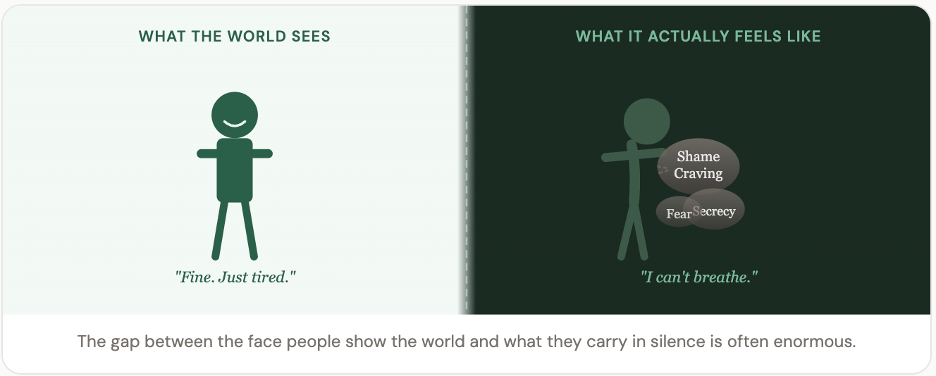
Here is where the silence comes in. Because once the cycle has taken hold, one of the most consistent experiences people describe is a profound, creeping sense of shame and the isolation that follows it.
They know something is wrong. They can see it happening. And they cannot stop. That gap between knowing and doing is one of the most painful places a human being can inhabit.
"I would promise myself every single night that tomorrow would be different. And I believed it every time. And then tomorrow would come."
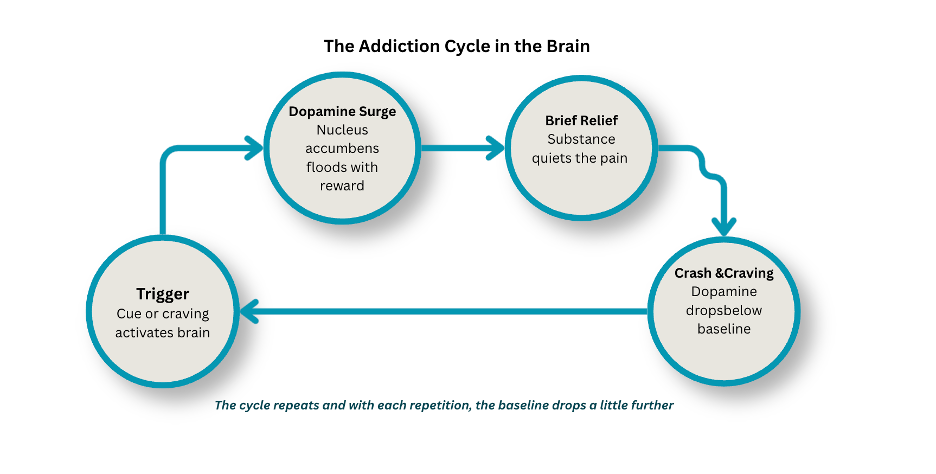
Studies on the neuroscience of addiction has described this clearly: addictive substances produce shame as a near-inevitable consequence, because they are perceived as indulgent and shame, being so painful, only intensifies the need for relief and escape. The cycle feeds itself.
A landmark 2023 review in World Psychiatry by Volkow and Blanco confirmed that long-lasting changes in brain networks involved in reward, executive function, stress reactivity, and self-awareness underlie the intense drive to use substances and the inability to control that urge even when the person desperately wants to. It is not stubbornness. It is neurology.
The Exhaustion Nobody Sees
Think about what it costs to maintain addiction in secret. To perform normalcy at work while your body is in withdrawal. To smile at a family dinner while counting the hours until you can be alone. To construct an entire parallel life that no one around you can see.
The effort involved is staggering. And it is completely invisible.
People living with addiction are often described as selfish, as checked out, as not caring. What that framing misses is the sheer cognitive and emotional labor happening beneath the surface. The constant negotiation: how much, when, where, who might notice. The mental arithmetic of managing a secret that has grown larger than you are.
A woman I’ll call Thandi described it this way: “People thought I was distant. That I didn’t care anymore. The truth was I was so busy managing everything, keeping it all invisible, that I had nothing left. There was no more me.”
Craving Is Not Just a Want. It’s a Signal
One of the most misunderstood aspects of addiction is the nature of craving. From the outside, craving looks like selfishness. Like someone simply choosing their substance over the people who love them.
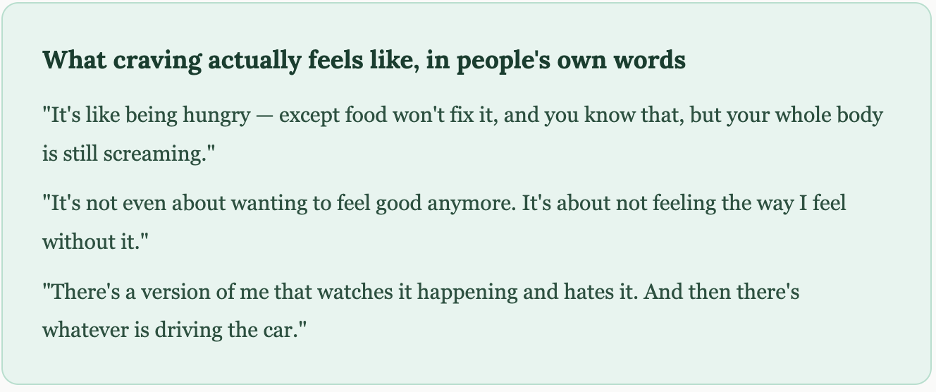
From the inside, it is something far more disorienting. Research drawing on both neuroscience and first-person testimony has found that craving comes in distinct forms triggered by environmental cues, fueled by unresolved emotional pain, and sometimes rooted in something closer to attachment than desire. It is not always dramatic. Sometimes it is a quiet pull, like the tide, steady and almost imperceptible until you are already in the water.
Contemporary addiction science describes a key pattern: repeated stress and repeated substance use push the nervous system toward a higher baseline of distress a state of amplified negative emotion and craving that creates a self-reinforcing loop. Many people in recovery describe it simply as “I didn’t even want to use. My body just moved toward it.”
That is not weakness. That is a nervous system that has been deeply conditioned.
The Loneliness Inside the Crowd
Perhaps the most universal thing I hear from people who have lived with addiction is this: they were surrounded by people who loved them, and they had never felt more alone.
That aloneness is not incidental. It is part of the architecture of addiction. Shame drives secrecy. Secrecy drives isolation. Isolation removes the one thing that neuroscience consistently identifies as the most powerful protective factor in recovery: human connection.
Research has shown that peer support, role modeling, and genuine community are among the most effective mechanisms in sustaining recovery because they directly address the shame and loneliness that fuel continued use. The sense of belonging to a community of peers helps diminish the isolation at the core of addiction.
This is why recovery is rarely just about stopping. It is about building a life where you no longer need to escape from it. That is a much bigger project. And it almost always requires other people.
What We Owe Each Other
If addiction feels the way this article describes quietly, invisibly, exhaustingly then the response it deserves is not judgment. It is witness. The willingness to sit with someone in their reality without flinching, without fixing, without making it about our discomfort.
The science supports this. Shame, when it follows a relapse or a disclosure, activates the very pain systems that drove substance use in the first place. It does not motivate recovery. It deepens the need for relief. Compassion, by contrast, reduces the neurological threat response and creates the safety that makes honest help possible.
This does not mean there are no hard conversations. There are. But they land differently when the person having them knows they are not being abandoned.
Addiction is not a character flaw dressed up in medical language. It is a real, painful, human experience that asks something of all of us not just the person living it. It asks us to look honestly at what relief, connection, and belonging mean, and what happens when people can’t find them any other way.
If you are someone who has lived this in any form I want you to know that what you have been carrying is heavier than most people understand. And that the fact that you are still here, still reading, still trying to make sense of it, is not nothing. It is, in fact, a great deal.
Recovery is possible. Not because the struggle disappears, but because people find ways to carry it differently with more support, more understanding, and less of it alone.

If this resonated with you, share it with someone who might need to hear it. Sometimes the most powerful thing we can do is remind someone they are not alone.
References
- Pickard, H. (2024). Craving for drugs. Mind & Language. Wiley Online Library
- Inagaki, T.K. et al. (2021). The role of social isolation in opioid addiction. Social Cognitive and Affective Neuroscience, 16(7), 645–655. Oxford Academic
- Lewis, M. (2017). Addiction and the brain: Development, not disease. Neuroethics. PMC5486526
- Volkow, N.D. & Blanco, C. (2023). Substance use disorders: a comprehensive update. World Psychiatry, 22, 203–229. Wiley Online Library
- Sinha, R. (2024). Chronic stress and addiction. Synthesized in: Stress, the Nervous System, and Substance Use Recovery (2026). Top of the World Ranch
- Goldstein, R.Z. & Volkow, N.D. (2011). Dysfunction of the prefrontal cortex in addiction. Nature Reviews Neuroscience, 12, 652–669. PMC3462342